
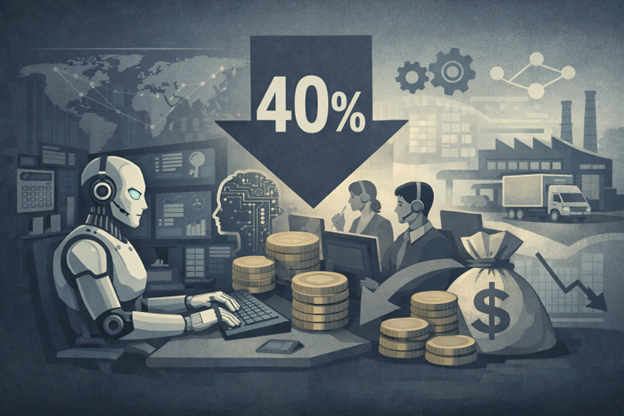
Scalability is very important for businesses today. Companies need to handle quick growth, sudden increases in demand during certain times of the year, and changes in the market without losing quality or efficiency. In the past, business process outsourcing (BPO) mainly used human workers, which made it hard to scale up quickly. But in 2026, artificial intelligence (AI) has changed this. It allows BPO companies to create operations that are more flexible, efficient, and able to grow with the business.
The Need for Scalable BPO Operations
Companies grow in unpredictable ways. When they launch new products, go into new markets, or face a sudden rush in orders, they need to scale their operations quickly. However, internal teams or traditional outsourcing methods have several challenges:
– Hiring and training new workers takes a long time.
– Scaling up infrastructure costs a lot of money.
– More work leads to more mistakes, which lowers the quality of service.
AI helps solve these problems by doing repetitive tasks automatically, helping human employees, and making workflows more efficient. This creates BPO operations that can grow quickly along with the company.
AI-Powered Automation Enables Rapid Scaling
Automation is a key part of scalable BPO operations. Tasks like entering data, checking it, making reports, or handling documents can be done by AI. This allows BPO providers to:
– Handle more work without needing additional human resources.
– Keep their work accurate and efficient even when they’re busy.
– Quickly respond to changes in the market.
For example, a retail BPO company used AI in its order management. During busy sales times, the system handled three times as many orders as usual without needing more staff. This eliminated delays and kept service quality high.
Case Study 1: E-Commerce Scalability
An e-commerce company needed to manage orders during the Christmas season, which used to cause late shipments and unhappy customers. By using AI-driven BPO services, they:
– Automated order checking and tracking.
– Human workers only dealt with special cases or important orders.
– Handled the rush 2.8 times faster than before.
This allowed the company to meet customer demand, keep customers happy, and increase sales without spending more on infrastructure.
Predictive Analytics for Proactive Scaling
AI doesn’t just automate, it also predicts. By looking at past and current data, AI helps BPO providers guess when demand will go up, manage resources better, and plan workflows more efficiently. A logistics BPO used AI to predict how many shipments would happen based on past trends and current market conditions. This let them:
– Prepare resources before demand increased.
– Avoid delays and bottlenecks.
– Handle peak times 25% faster.
Predictive scaling helps businesses be ready for growth before it happens, keeping service quality and efficiency high.
Consistency and Quality at Scale
Manually scaling operations often leads to mistakes, inconsistency, and worse service.
AI helps maintain quality by guiding human workers, watching over processes, and giving real-time warnings when things go wrong. For instance, a BPO that deals with financial data uses AI checks. Even when they handled three times as much work, the accuracy improved by 30%. This shows that AI helps keep quality high even as the workload increases.
Faster Onboarding and Training with AI
Training new workers can slow down growth. AI helps new employees get up to speed faster with real-time help, automated tasks, and smart suggestions. New hires can start working 50–60% quicker, allowing companies to grow without delays. A customer service BPO used AI for training new agents and cut the time needed from six weeks to just two weeks. This increased productivity and saved on training costs.
Strategic Scaling and Business Agility
AI helps companies scale in a smart and strategic way. BPO providers can:
– Find processes that are not working well.
– Move resources around as needed.
– Improve workflows to be more efficient.
– Predict demand and adjust how much capacity they need.
A SaaS company used an AI-enabled BPO for managing subscriptions. Using AI insights, the provider:
– Balanced workloads in real time.
– Cut response time by 35%.
– Scaled operations smoothly during product launches.
This shows that AI-powered BPO helps companies respond faster, scale more effectively, and keep service quality high.
Trends in 2026 Supporting AI-Driven Scalability
AI and Automation Integration: More businesses are using AI to automate workflows.
Data-Driven Insights: Continuous analysis helps make smarter scaling decisions.
Global Workforce Management: AI allows teams around the world to work together efficiently.
Outcome-Based Metrics: Companies now tie BPO performance to revenue and growth.
Hybrid Human-AI Model: Combining AI with human judgment gives flexibility and ensures good quality.
Conclusion
In today’s time, having scalable BPO operations is not a nice-to-have. It is essential for growing businesses. AI makes it possible to:
– Scale up quickly without spending a lot more.
– Keep quality and accuracy high even during busy times.
– Use resources more efficiently by predicting and preparing.
– Help new workers learn faster, increasing productivity.
– Make better decisions using data.
Companies that use AI in their BPO operations can grow smoothly, keep service quality high, and act faster on market opportunities than competitors. AI-driven BPO is the foundation of modern, scalable operations, helping businesses achieve long-term growth and excellent performance.